


Ernest Fiset's Bachelor Years: Prairie Work
The story of my great-grandfather, Ernest Fiset, emerges through fragments—old photographs, bank books, notebooks, and family memories. I am weaving these pieces together into a narrative family history about his life as a homesteader in southern Saskatchewan after the First World War. This excerpt explores his bachelor years, when he was building his farm, hiring harvest hands, and embracing the new machinery that was changing prairie agriculture.
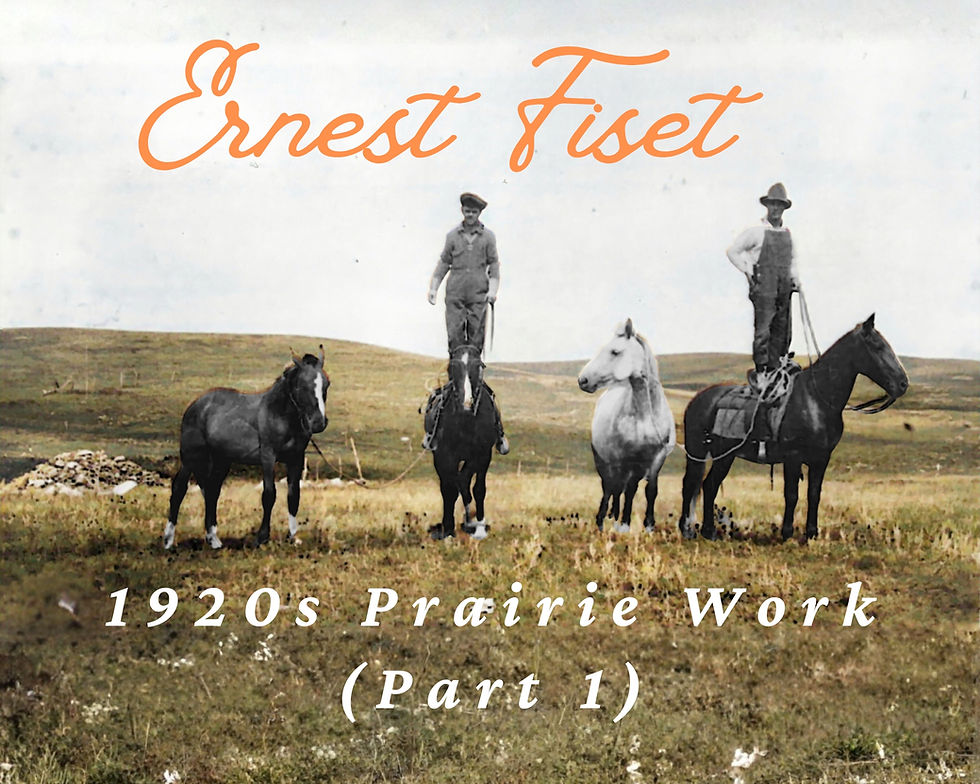
I sift through a small cardboard box that perhaps once held greeting cards, its lid long since gone. The cardboard is soft with age, its corners worn from years of handling. For decades the box lay under Ernest’s bed in his tiny house. Now Auntie May has entrusted its contents to me to help tell our family story.

It feels strange to look through the remains of what someone kept tucked away for more than fifty years. How does one decide what to keep forever and what to throw away? What do the remaining artefacts mean? Presumably, their preservation suggests that Ernest attached some significance to the bits and pieces contained within.
The items include nineteenth century tintypes, two bank books, four tiny notebooks, and a set of 1919 postcards from the Cunard Steam Ship Co wishing returning soldiers “a safe and pleasant voyage back to [their] Homeland.”
Ernest was twenty-three years old when he returned home from England at the end of World War I. He applied for a Soldier’s Homestead Grant that expanded his farm from a quarter section to a half section of land.
“When I come back, I had $500 in my pocket. Never had that in my life!”[1]
He got straight to work.
I envision Ernest carefully tracking expenditures, bringing in his harvests, and planning – ever planning. Inside the little cardboard box is a black bank account booklet for 1921-22 that he later used as a general journal. He wrote in both English and French – neither language spelled perfectly - and the details he included are sparse, yet telling.
By late August the Saskatchewan harvest was already underway, and from August 29 through September 12, 1922, he carefully tracked the number of partial or full days his hired hands worked: Dene Lavectoir, Arthur Mongraind, Henrey Fredterison, Gustav Goselin, Davide Dublenait, Telesford Matineux, and Mac Donletion – names preserved in Ernest’s own spelling.[2]
In September 1922, he travelled to Melaval – a village about 50 kilometres away – where he bought “2 fourche” and a “cheval a sel au sud” – two pitchforks and a saddlehorse meant for riding rather than farmwork. That same month he took another trip to the Sletter household to deliver $800 in cash. What did he buy? Horses? Building materials? Tools? The possibilities are as varied as the improvements he made and the ventures he embarked upon.

Ernest had grown up around horses since boyhood in Quebec. They pulled sleds, plowed the farm, logged the forests, and carried the family to town. Though short in stature, Ernest grew tough and strong and loved working with saddle and work horses alike.
But he had been born in 1895, on the cusp of a new age and early on he was in awe of the possibilities of machines. One family story tells how, when he was about thirteen years old in Ste. Christine, Quebec, he heard that a motorcar would be passing through a nearby town. This was something he had to see. He climbed on his horse and rode all day to catch a glimpse of it. What a marvel!

Given this curiosity, it’s not surprising that Ernest would become interested in the latest farming technology. Tractors were the wave of the future. Salesmen visited farms touting their benefits: “better and deeper plowing, putting the seed bed in finest possible condition, working more acreage, road work, heavy belt work, pulling stumps, and many more possibilities.”[3] These promises fell on fertile ears – for Ernest and for many other farmers in the district.
In the summer of 2019, Auntie May descended on our family reunion with boxes full of photographs. One photo stood out because of its bulky size.
“Do you want this photo?” Auntie May asked. “I’ve tried, but I can’t find my dad in it.”
Of course I wanted it.
In the photo a large group of men stands posed in front of a one-storey wooden building: “J.W. Graham, International Farm Machines.” Snow lies on the ground.[4]

Once home, I took out a magnifying glass and began studying the blurry faces. It didn’t take long until – there!
Dead centre in the photograph, thirty-one-year-old Great-Grandpa Fiset peered out, wearing a light-coloured cap. He was one of nearly ninety men and farm lads who had travelled to Assiniboia in the spring of 1927 to attend the I.N.C. Tractor School.

The tractor school was created to help owners and labourers learn how to maintain and troubleshoot their machines rather than become frustrated when small problems arose and call the dealer out to the farm “for reasons which often were foolish.”[5] The editor of Canadian Farm Implements explained the logic:
“The man who can keep his machine going, and who knows in a thorough manner its operation and maintenance, is a satisfied customer, and… a good advertisement for the tractor he owns. By all means let the dealer start the owner right when he sells a machine, but in every case dealers should endorse attendance at a tractor school as a means of learning pointers which may be of infinite value in the future operation of the machine."[6]
A bumper wheat crop in 1924 must have made Ernest feel like he was on top of the world. He was eager to maximize his production even further by investing in one of the tractor machines. Little did he know the hardships that lay in wait upon the horizon.
(To be continued)
Sources:
[1] Ernest Fiset interview with granddaughter, Beverly (Honeyman) Inkster, August 5, 1982 at Lumby, BC.
[2] Black “Banque D’Hocheloga” account book for Ernest Fiset, Lafleche, Saskatchewan branch. Contains bank entries for 1921-22 and sporadic financial journal entries related to employees and money owing him from 1922 to 1934. In possession of author.
[3] “Instructional Schools,” Canadian Farm Implements (March 1923): 14, https://archive.org/details/canadianfarmimp1923donm/page/n77/mode/2up
[4] G. M. Matson, “Concerning Tractor Salesmanship,” Canadian Farm Implements (October 1918): 26, https://archive.org/details/canadianfarmimp1918donm/page/n373/mode/2up?q=Matson
[5] Photo of I.N.C. Tractor School, Assiniboia 1927, photo by B. Dailsford, Estevan. In possession of author.
[6] “Instructional Schools,” Canadian Farm Implements (March 1923): 14, https://archive.org/details/canadianfarmimp1923donm/page/n77/mode/2up


Comments